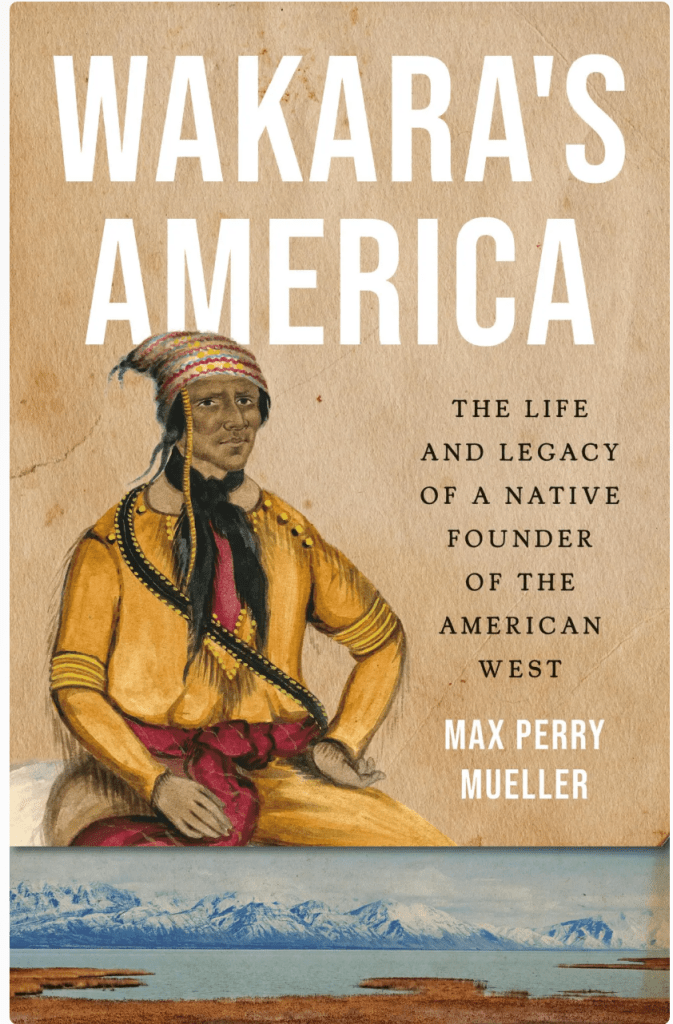
My second book, Wakara America: The Life and Legacy of a Native Founder of the American West (Basic Books, November 2025), explores how writing—especially the writing of national origin narratives—has shaped religious, ethnic (including tribal), and political identities in America and shaped the political and environmental landscapes of the West.
In Wakara’s America, the first full-length biography of the influential Ute leader, I argue that Wakara (c. 1815–1855) should be counted among the founding figures of the American West. During the mid-nineteenth century, Wakara and his pan-tribal cavalry of horse thieves and slave traders dominated the Old Spanish Trail, the region’s most important overland route. They widened the trail and expanded its watering holes, reshaping the environmental and geographical boundaries of the region. They also exacted tribute from travelers passing along the trail and assisted the trail’s explorers with their mapmaking projects—projects that shaped the political and cultural boundaries of the West. What’s more, as the West’s greatest horse thief and horse trader as well as the region’s most prolific trader in enslaved Indians, Wakara supplied Spanish, Mexican, and Anglo-American settlers from Santa Fe to San Bernardino with the labor and horsepower that fueled empire and settler colonial expansion as well as fueled great changes to the West’s environmental landscape.
In the late 1840s, Wakara became a crucial force in the colonization of the West. Soon after the Latter-day Saints arrived in the Great Basin, Wakara struck a bargain with Brigham Young: in exchange for cattle, guns, and promises to buy his horses and Native captives, Wakara approved and personally oversaw the first Mormon settlements outside the Salt Lake Valley. Wakara was baptized into the Mormon faith and encouraged his followers to do the same. He also became the first Utah Native ordained into the Mormon priesthood. Yet Wakara’s collaborations with the Mormons was borne not out of religious devotion but instead out of strategic pragmatism. He used Mormon colonial systems of commerce, violence, and religious conversion to expand his own power—directing the Mormons to settle the lands of rival Ute bands, which the Mormons then displaced or massacred. These settlements enriched Wakara by adding markets for his captives and stolen horses.
Yet Wakara also became one of the West’s greatest defenders of Native sovereignty. When Mormon settlers destroyed his people’s sacred fishing and hunting grounds and threatened to take over his slave trade, Wakara led an uprising that temporarily halted colonial expansion. His death in 1855—from disease or poison—was marked by a pharaoh-like burial in which horses, wives, and enslaved Paiute children were killed and interred with Wakara in his mountainside tomb. In 1872, U.S. Army ethnologists desecrated his grave, removing Wakara’s skull and those of six others for study in Washington, D.C.
Despite his significance to the founding histories of New Mexico, California, and Utah, Wakara has been largely absent from origin stories of the West. When he does appear, Wakara has most often been reduced to playing the role of the incorrigible savage Indian in what Richard White has called the theater of “inverted conquest.” Euro-American settlers (and their historians) have recast the narrative of the West so that they, and not American Indians like Wakara—whose land the settlers took through force, deceit, and disease—were the victims of unprovoked aggression. Wakara’s America recovers Wakara’s environmental, spiritual, and political worlds by drawing on material as well as written archives. Each chapter focuses on an object—from “Wakara’s Fish,” the sacred animals that Wakara’s Utes managed for several hundred years and defined them as “fish eaters,” but were decimated by Mormon irrigation within a few decades of the settlers’ arrival, to “Wakara’s Skull,” exhumed and measured by ethnologists to classify racial hierarchies.
Wakara’s America has received advance praise from some of the leading scholars of American history. The book has received praise for its contributions to the understanding of Native resource management (based on traditional ecological knowledge (TEK)) in contrast with settlers’ human-centered environmental exploitation, as well as its study of the relationships among slavery, violence, and Native sovereignty and resilience in the creation of the cultural and environmental boundaries of the American West.
 Max Perry Mueller